Our concerns & Reccomended Standards
Data Center Accountability for the citizens of Dubuque County

The concerns below reflect issues documented in communities across the United States and worldwide where large-scale data centers have been built, together with items raised by Dubuque County residents. Each item represents a topic the Zoning Commission may wish to address through specific, enforceable ordinance standards before applications are considered.
1. Farmland, Siting, and Land Use
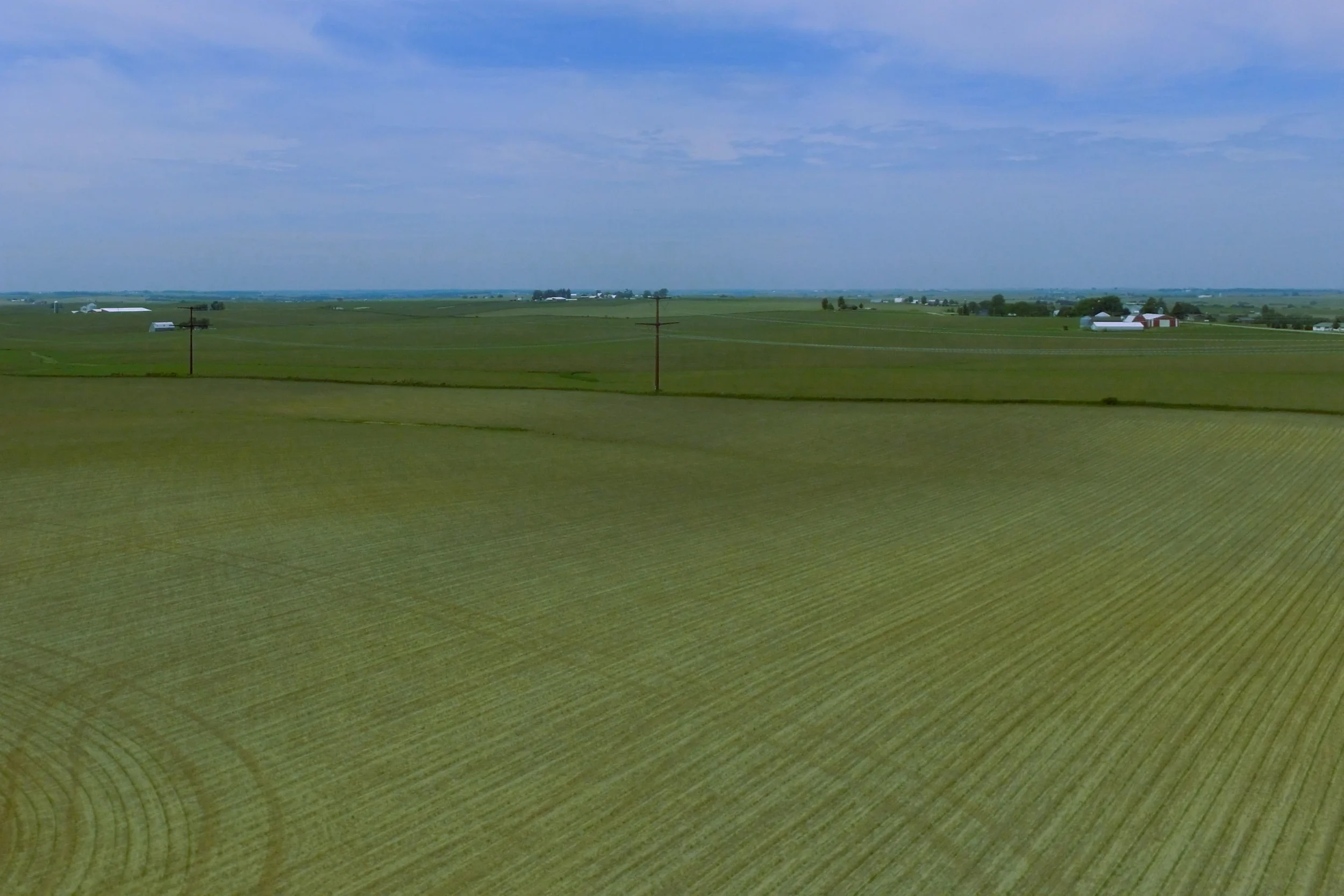
Permanent loss of high-quality agricultural land; once prime farmland is converted to industrial use, it does not return to production.
Siting on high-productivity soils (e.g., high CSR2-rated ground in Iowa); lower-quality or already-industrial sites should be used where available.
Applicants should be required to demonstrate that no suitable previously-developed site — brownfields, existing industrial parcels, or other already-disturbed land — was available before proposing to build on viable farmland, and to explain why any such alternative was rejected.
Incompatibility of industrial-scale buildings with agricultural and rural residential zoning districts.
Fragmentation of contiguous farm operations and interference with field access, drainage tile, and farm equipment movement.
Pressure for speculative rezoning of surrounding parcels once a first facility is approved.
Need for a density clause limiting the number and concentration of data center campuses in the county so that approvals do not cluster into a de facto industrial corridor.
Setback from municipal boundaries: Allamakee County, Iowa prohibits data centers within two miles of city limits — a model worth considering, which also reduces annexation pressure.
Size definitions and thresholds should be based on total campus acreage, not building square footage; rezoning requests are presented and approved at the campus level, and building-size definitions invite phased end-runs around thresholds.
Minimum setbacks for data center buildings, generators, substations, and mechanical equipment from dwellings, schools, churches, parks, and other sensitive uses — the separation neighbors will care about most. Setbacks should be measured to the property line of any non-participating landowner.
Height limits for data center buildings and structures, consistent with the rural character of the county and with airport airspace protections.
Aggregation rule: parcels under common ownership, control, or coordinated development — including affiliated LLCs and phased projects on adjacent land — must be counted together as a single campus, so thresholds cannot be evaded by subdividing a project among related entities.
Any rezoning request should align with the Dubuque County Comprehensive Plan.
2. Water Use and Water Quality
Evaporative cooling consumes enormous volumes of water — some facilities use millions of gallons per day, competing with municipal, agricultural, and residential wells. For this reason, the ordinance should require closed-loop cooling systems for all data centers and prohibit evaporative and once-through cooling.
Closed-loop operation must be maintained at all times, including periods of peak power demand or high energy prices. In Aurora, Illinois, facilities switched from closed-loop to evaporative cooling when electricity rates were high — wasting far more water precisely when the grid was most stressed. The ordinance must prohibit this switching, with monitoring and penalties.
Drawdown of local aquifers and impacts on private well owners, with limited recourse for affected neighbors.
Shared wells deserve specific attention: where several households draw from a single shared well, a drop in water level or pressure caused by data center consumption or redirection affects all of those families at once, compounding the harm.
Required pre-construction well studies of surrounding properties and continuous water quality and water level monitoring for the life of the facility, at the operator's expense.
Every application must include a complete closed-loop system plan: maintenance schedule, leak detection and response, flushing intervals and procedures, contaminant monitoring and separation, and refilling procedures and volumes.
Discharge of heated water, blowdown water, and water-treatment chemicals into streams or sewer systems.
Stormwater runoff from large impervious rooftops and parking areas, increasing flooding and erosion downstream.
Lack of disclosure: in many communities, water use figures were kept confidential until after approval.
Applicants must disclose minimum, maximum, and average water use and water usage effectiveness (WUE), broken out by potable and non-potable sources, and the ordinance should set enforceable standards for each (see the Sierra Club data center checklist and the Center for Water Policy's model legislation, 'AI Data Centers: Legislative Model to Promote Transparency and Environmental Protections,' March 2026).
Drought and water-service priority: the ordinance should establish that in times of drought or supply shortage, essential water needs — hospitals, schools, residences, fire protection, and livestock — take priority, and data center water service is curtailed first.
All water infrastructure costs — wells, mains, treatment, storage, and any system improvements required to serve the facility — must be paid by the applicant, not by ratepayers or taxpayers.
3. Karst Geology, Sinkholes, Floodplains, and Groundwater Protection
Much of Dubuque County lies within the Driftless Area, where shallow, fractured limestone and dolomite bedrock creates karst conditions: sinkholes, losing streams, springs, and rapid pathways from the surface directly into the aquifers that supply drinking water. Contaminants entering a sinkhole receive little or no natural filtration.
Mandatory setbacks for data center buildings, fuel storage, chemical storage, stormwater basins, and wastewater infrastructure from mapped sinkholes, karst features, losing streams, and springs.
A required karst and geologic site investigation by a qualified independent geologist before any application is accepted, including identification of unmapped karst features on and adjacent to the site.
Prohibition on siting in areas of active or high-density sinkhole formation, where subsidence also threatens the structures themselves.
Secondary containment for all fuel and chemical storage, sized and designed for karst terrain, with groundwater monitoring wells around the facility.
Stormwater designs that do not concentrate infiltration near karst features; a pond or basin placed over a sinkhole becomes a direct injection point to the aquifer.
Prohibition on siting data center buildings, fuel storage, and hazardous materials in mapped floodplains and wetlands, with buffers from streams and drainage ways.
4. Electrical Grid and Energy
Enormous electrical demand — a single large campus can use as much power as a city — straining the regional grid.
Proof of excess power capacity: applicants must provide documented verification from the serving utility and regional grid operator that at least 150% of the facility's projected peak demand is available as excess capacity — beyond existing committed load — before an application is accepted, so a project cannot be approved on power that does not yet exist or that would be taken from existing customers.
Rate increases for residential and small-business customers when utilities build new generation and transmission to serve data centers (documented in Virginia, Georgia, Ohio, and elsewhere).
New high-voltage transmission lines and substations crossing farms and rural neighborhoods.
High-voltage transmission lines and substations produce their own continuous hum and buzzing, which affects residents and wildlife in addition to the noise from the facility itself.
Reliability risk: large loads connecting or disconnecting can destabilize local grid segments.
On-site fossil generation (diesel or gas turbines) used as primary or bridge power when grid capacity lags.
Require a backup power plan with operating restrictions, together with a generator testing plan specifying frequency, duration, permitted hours, and neighbor notification.
Cap total non-emergency generator operating hours per year. Without a cap, a 'backup' diesel fleet can be enrolled in utility demand-response programs and run regularly for profit — with all the noise and emissions of a power plant — while remaining legally 'backup.'
Underground and overhead line routes must not interfere with non-participating parcels and must be installed at the applicant's expense.
A plan identifying all grid interconnection points must be established and demonstrated suitable before approval.
Require the data center to supply a set percentage of its power load from renewable sources.
All electrical infrastructure costs — transmission, substations, interconnection, and any grid upgrades required to serve the facility — must be paid by the applicant, not passed through to other ratepayers.
5. Airport and Aviation Safety
Proximity to the Dubuque Regional Airport raises specific hazards that require FAA review before local approval.
The airport's heavy presence of student pilots and small general-aviation aircraft, which operate at lower altitudes and are more vulnerable to plume turbulence and visibility hazards.
Structure and crane heights penetrating FAR Part 77 airspace surfaces (FAA Form 7460-1 obstruction review).
Thermal plumes from cooling equipment and generator exhaust creating turbulence hazards for low-flying aircraft (per FAA guidance in AIM 7-6-16).
Steam from exhaust and cooling towers can cause icing on aircraft operating in the vicinity of the site.
Glint and glare from rooftop solar or reflective surfaces affecting pilots on approach.
Electromagnetic interference with navigation aids, radar, and communications.
Stormwater ponds attracting wildlife/birds near runways (FAA AC 150/5200-33 wildlife hazard guidance).
Potential effects on aerial events and transient traffic — Fourth of July displays and flyovers, NATA, and the heavy general-aviation traffic transiting the region for EAA AirVenture Oshkosh.
6. Noise
Continuous, 24/7 low-frequency hum from cooling fans and chillers — a leading complaint in communities near existing facilities (e.g., Chandler, AZ; Loudoun County, VA).
Periodic testing of banks of diesel backup generators, often exceeding 90 dB nearby.
Tonal noise that is more disturbing than broadband noise at the same measured level.
Standards must include C-weighted (dBC) limits in addition to A-weighted limits, because A-weighting understates the low-frequency noise data centers produce.
Noise-generating activities — generator testing, outdoor maintenance, construction, and deliveries — should be limited to daytime hours.
Rooftop generator placement allows noise to carry much further than ground-level placement; the ordinance should require ground-level siting with sound attenuation.
Noise from generator testing must be limited in level, duration, and frequency, with advance notice to neighbors.
Enforceable standards measured at the property line or road right-of-way against a pre-construction background (L90) baseline, with absolute limits and penalties for tonal noise.
The L90 baseline must be measured by a county-selected acoustic consultant, at the operator's expense, at representative locations and times — before any site work begins — so the applicant cannot schedule or site the measurement to lock in an artificially loud baseline.
Standards must address infrasound and low-frequency noise (below 20 Hz). Infrasound can travel for miles, passes through buildings and ordinary acoustic barriers, and is felt as internal pressure or vibration rather than heard — a documented characteristic of large mechanical cooling systems that A-weighted limits entirely miss.
Baseline sound surveys and noise mapping should be produced by an independent agency within at least a one-mile radius of the site, using rigorous methods — including noise spectral density, octave-band or FFT analysis, Z-weighting, and Class 1 sound-level metering — rather than a single broadband reading.
7. Air Quality, Dust, and Emissions
Diesel backup generator fleets — sometimes dozens to hundreds of engines — emitting NOx, particulate matter, and CO2 during testing and outages.
Dust control requirements during construction and operation, enforceable on unpaved surfaces and material handling.
Carbon emission restrictions or reporting requirements for on-site generation.
On-site fuel storage in large quantities, with spill and fire risk.
Cooling tower drift releasing water-treatment chemicals into the air.
8. Fire, Safety, and Hazardous Materials
Lithium-ion battery energy storage systems with thermal-runaway fire risk exceeding rural fire department capabilities.
Large diesel fuel storage and refrigerant inventories requiring hazmat response capacity.
Burden on volunteer or small-town fire and EMS services without compensating funding or training.
Emergency response plans must be required, developed in coordination with local fire and EMS, and regularly inspected and updated.
The emergency response plan must identify the specific water source(s) and available water pressure firefighters would rely on for a facility fire, and confirm they are adequate; large data-center fires can exceed both rural water supply and the capacity of volunteer departments, and the added burden could itself deter volunteer recruitment and retention.
9. Lighting, Visual, and Character Impacts
Massive warehouse-scale buildings out of scale with rural landscapes.
Security lighting and light pollution affecting neighbors and the night sky.
Visual pollution and loss of rural character, scenic views, and quality of life that drew residents to the area.
Protection of views along designated state and national scenic byways (e.g., the Great River Road) from data center development.
Perimeter fencing, guard structures, and industrial appearance incompatible with surrounding uses.
10. Traffic and Infrastructure
Required independent road and traffic studies before approval, with binding road-improvement and maintenance agreements.
Multi-year construction traffic — heavy trucks, concrete, and oversized loads — damaging county roads not built for such loads.
Road upgrade and maintenance costs shifted to county taxpayers without developer cost-sharing agreements.
Ongoing service, delivery, and fuel-truck traffic after construction.
Personal safety of residents and pedestrians: many rural roads have no shoulders, limited sight lines, blind hills, and hidden driveways. Increased or redirected traffic — much of it drivers unfamiliar with the area — raises real danger for residents, pedestrians, and especially children, and should be evaluated in the required traffic study.
11. Property Values and Neighboring Landowners
Documented declines in residential property values near large data center campuses.
Difficulty selling homes and farms in proximity to, near, or adjacent to industrial facilities; the effect on value and buyer interest is documented to reach well beyond directly-abutting parcels.
Bonded compensation mechanisms for neighbors harmed by noise, lighting, well interference, or lost property value (see Section 16).
12. Public Health of Neighboring Residents
Chronic exposure to continuous 24/7 industrial noise is linked to sleep disruption, elevated stress hormones, hypertension, and cardiovascular effects; the World Health Organization treats environmental noise as a serious public health issue, and residents near existing data centers report exactly these harms.
Diesel generator emissions — fine particulate matter (PM2.5) and NOx — near homes, schools, and farms, with health effects that occur even at low concentrations and during routine testing, not just outages.
Contamination risk to private drinking-water wells, magnified in karst terrain (Section 3).
Light at night disrupts sleep for nearby residents.
Critically, there are no long-term epidemiological studies of the health effects of living near hyperscale data center campuses — the industry at this scale is simply too new. The absence of evidence of harm is not evidence of safety. This gap argues for a precautionary approach: larger setbacks, stricter performance limits, and continuous monitoring, with the burden of proof on the applicant rather than on residents.
Require applicants to fund baseline community health documentation (noise, air, water) before construction so that future harms can actually be measured and attributed.
Individual sensitivity varies: a noise or light level deemed generally 'acceptable' may still harm particular residents — people with PTSD (including veterans) for whom construction and blasting are triggering, shift workers sleeping during the day, households with napping infants, and others who are highly sensitive. Continuous, cumulative stimulation of the nervous system is an under-studied but real health concern, and this argues for standards set conservatively rather than at the edge of what is 'generally tolerable.'
Some communities report increased local health-care costs after data center development.
The county or an appropriate public-health body should establish and maintain a public adverse-event reporting portal, so residents can log health, property, noise, and environmental changes over time — creating the monitoring record that currently does not exist for facilities at this scale.
13. Livestock, Pets, Wildlife, and Animal Agriculture
Continuous noise and vibration stress on livestock — documented to affect feed intake, weight gain, milk production, and reproduction in cattle, and to cause piling and mortality events in poultry.
Stray voltage and ground currents from substations and high-voltage transmission serving the facility — a well-documented problem for dairy herds, affecting milk production and animal health.
Similar noise, vibration, and light impacts on pets and companion animals of nearby residents.
Light pollution disrupting wildlife, migratory birds, bats, and pollinators, and altering predator-prey behavior around neighboring farms.
Habitat loss and fragmentation from campus footprints, perimeter fencing, and new transmission corridors.
Federally protected bald eagles winter in the Driftless Area around Dubuque County and are highly sensitive to noise and human presence; facility hum and heavy machinery can stress them into abandoning roosts and nests. Relocating a nest does not resolve the harm, because it does not restore the surrounding flying and hunting habitat. Protection is also a legal obligation under the Bald and Golden Eagle Protection Act.
Water drawdown and thermal or chemical discharge affecting streams — including the Driftless Area's coldwater trout streams, which depend on the same groundwater a data center would pump.
Require an agricultural and wildlife impact study, prepared by an independent third party, as part of every application, with setbacks from existing livestock operations.
14. Economic, Fiscal, and Labor Concerns
Few permanent jobs relative to land, water, and power consumed — large facilities commonly employ only 30–150 people once operating.
Large property tax abatements and incentives that reduce the promised local fiscal benefit for decades.
Construction jobs frequently filled by out-of-area contractors rather than local workers; require union or prevailing wages and local hiring commitments.
Risk of stranded assets: rapid technology change may leave obsolete buildings before abatements expire.
15. Waste, Decommissioning, and Site Restoration
A cradle-to-grave clause making the operator responsible for the facility and its impacts from construction through final site restoration, regardless of ownership changes.
No guarantee facilities remain in operation for their projected life; ordinances should require decommissioning plans and financial assurance for demolition and site restoration.
Ongoing waste management requirements, including electronic waste recycling for the continuous stream of retired servers and hardware, not just end-of-life disposal.
Restoration of soil and drainage if land is to return to agriculture.
16. Enforcement, Bonds, and Financial Assurance
Bonds or escrowed funds covering: environmental damage, property devaluation of neighboring parcels, compensation for damage to wells and property, and full decommissioning costs.
Substantial daily penalties for each day a violation continues, large enough to matter to a multi-billion-dollar operator.
A graduated enforcement ladder written into the ordinance: operational sanctions, cease-and-desist authority, and permit termination for repeated or serious violations.
Evidence of adequate insurance as a condition of application acceptance and continued operation.
Bond amounts must be indexed to inflation and recalculated periodically (e.g., every five years) by a county-selected estimator at the operator's expense; a decommissioning bond set in today's dollars will cover only a fraction of demolition costs decades from now.
Because the named permittee will typically be a special-purpose LLC with no assets, require a written parent-company guarantee — filed with the county — making the ultimate corporate parent jointly responsible for all bonds, penalties, and decommissioning obligations.
Emission, noise, and water standards must be written as enforceable performance standards with monitoring — not aspirational goals.
17. Ongoing Monitoring, Cumulative Impacts, and Continuing Compliance
Approval cannot be a one-time sign-off. Compliance must be a continuing obligation for the life of the facility, and impacts must be assessed regionally, not parcel by parcel.
Regional cumulative-impact studies for water, power, and air: the aquifers Dubuque County residents depend on do not stop at the county line. One data center may withdraw X gallons or megawatts, but several facilities across a region draw far more — damage a single-county, single-application review will never expose until after the fact. Applications must be evaluated against existing and pending regional demand.
Cumulative studies must be repeated on a regular schedule, not performed once at application — conditions change as regional development proceeds.
A recurring (e.g., quarterly) environmental and social impact report filed with the county, covering water use, energy use, noise and air monitoring results, complaints received and resolved, and employment figures.
A formal complaint mechanism: a 24/7 operator contact, a publicly posted complaint line, a written log of all complaints provided to the county, and mandatory response and resolution timelines — the everyday enforcement tool neighbors will actually use.
Compliance is a continuing obligation: permits should be subject to periodic county review, with monitoring data verified by county-selected third parties at the operator's expense, and standards enforceable at any time — not only at approval.
18. Transparency, Process, and Application Requirements
Widespread use of non-disclosure agreements (NDAs) with local officials, shell LLCs, and code-named projects that prevent residents from knowing who the developer is or what is planned until approvals are nearly complete.
County officials and employees should commit to no NDAs and to full compliance with Iowa open meetings and public records laws (Iowa Code Chapters 21 and 22) and all other applicable state legislation and policies.
Any requirement that government officials, developers, or landowners sign an NDA during the process should disqualify the rezoning request.
All requirements — studies, information, bonds, monitoring plans, insurance — must be complete and submitted before a zoning request is accepted, not promised after approval. Approving zoning first and receiving information later reverses the proper order and forfeits the county's leverage.
Applicants must provide proof of long-term studies of comparable operating facilities, not projections alone.
Independent third-party review of water, noise, traffic, and grid studies — funded by the applicant but with the reviewing consultant selected by the county from its own approved list. A consultant the developer both pays and picks is not independent.
Minimum of 10 days' public notice for all filings and meetings, with meaningful hearings before rezoning or site plan approval and adequate time for residents to review technical materials.
Approval vehicle matters: data centers should be allowed only through a conditional use / special use permit process rather than straight rezoning. Rezoning creates a permanent entitlement that runs with the land — if the data center falls through, the parcel remains open to any industrial use. A conditional use permit lets the county attach every standard in this document as an enforceable permit condition and revoke the permit for violations.
The ordinance should preserve the Board of Supervisors' discretion to deny a rezoning request even when an application satisfies every checklist item; rezoning is a legislative act, and meeting minimum standards should not create an entitlement to approval.
Approvals must expire: if construction has not commenced within a defined period (e.g., two years), the approval lapses and a new application is required — preventing landbanking of entitlements while the regulatory environment shifts.
Permit and approval transfers to a new owner or operator require county consent, so entitled land cannot be flipped to an operator the county has never vetted.
Any change to a development plan after approval requires review by the Board of Supervisors and Zoning Commission.
19. Annexation and Jurisdictional Risk
Risk that city annexation (including irregular or 'shoestring' annexation under Iowa Code Chapter 368) could remove a project from county zoning authority after county standards are adopted.
Need for intergovernmental (28E) agreements between the county and cities to ensure consistent standards regardless of jurisdiction.
20. Related Standards for On-Site Renewables and Battery Storage
Data center campuses increasingly include on-site solar arrays and battery energy storage. The Zoning Commission's language should include:
Total impervious surface limited to 20% of the property for solar and 25% for battery storage.
A 50-foot height limit and a 1,320-foot (quarter-mile) setback from property lines and road right-of-way lines.
21. The Need for Strong Definitions
Weak or missing definitions are the single most common loophole in local ordinances. A developer facing a standard it does not like will argue its project is not a 'data center,' that its 'campus' is a series of separate small buildings, or that its cooling system is 'closed-loop' when it is not. The ordinance must open with a rigorous definitions section, including at minimum:
'Data center,' 'data center campus,' 'hyperscale,' 'colocation,' and 'edge facility' — defined by use and by campus acreage and aggregate power demand, not by individual building size, so phased or subdivided projects cannot evade thresholds.
'Closed-loop cooling system,' 'evaporative cooling,' 'potable water,' 'blowdown,' and 'water withdrawal' — so water claims are verifiable.
Noise terms: 'A-weighted (dBA)' and 'C-weighted (dBC)' levels, 'L90 background baseline,' 'tonal noise,' and 'property line measurement.'
'Excess power capacity,' 'committed load,' and 'projected peak demand' — so the 150% capacity requirement is enforceable.
'Karst feature,' 'sinkhole,' 'losing stream,' and 'spring' — tied to state geological survey mapping plus site investigation.
'Sensitive areas' thoroughly defined — non-participating parcels, public parks and wildlife management areas, karst areas, and similar protected locations.
'Decommissioning,' 'abandonment,' 'cessation of operations' (with a defined trigger, e.g., 12 consecutive months of non-operation), and 'site restoration.'
'Owner' and 'operator' defined to reach parent companies and successors, so obligations survive LLC transfers and ownership changes.
22. Construction Plan
Construction labor should be locally sourced and paid union wages.
Plans for water runoff, noise, erosion control, staging areas, interference with farm-to-market road access, dust, hours of operation, lighting, and traffic must all be in place prior to any rezoning approval.
A detailed description of the construction timeline.
Restrictions on blasting hours, with prior notification to neighboring residents.
23. Economic Development Agreement
No tax breaks or government subsidies.
Specific contributions, amounts, and recipients must be stated.
Job-creation assurances must be put in writing and made enforceable.
24. Required Studies and Descriptive Language
Any required studies must be performed by an independent third party at the applicant's expense, prior to any approval — with the consultant selected by the county from an approved list, not chosen by the applicant.
Monitoring standards, penalties, and site plan requirements must all be thoroughly described in the ordinance.
A cultural and archaeological resources survey should be among the required studies, and must specifically identify cemeteries, marked and unmarked graves, and burial sites. This region contains significant Native American and early-settlement sites, and disturbance without survey is irreversible; Iowa law provides specific protections for human burials (Iowa Code Chapter 523I and the Office of the State Archaeologist), which apply regardless of whether graves are marked.
The ordinance should include a severability clause, so that if any single provision is struck down in a legal challenge, the remainder of the ordinance stands.
Each of these concerns — and the ones discovered during the ordinance drafting process — must be translated into concrete ordinance language: definitions, siting criteria, performance standards, study requirements, financial assurances, and enforcement provisions. We respectfully ask the Zoning Commission to treat this list as a checklist — an ordinance that leaves any of these areas unaddressed leaves the county and its residents exposed.
Finally, this list — and any ordinance built from it — should be understood as a living document. Data center technology, scale, cooling methods, and power demands are changing rapidly, and new impacts continue to surface in communities across the country. The ordinance should include a mandatory review and update cycle (for example, annually or biennially, and after any completed project) so that its standards keep pace with the industry rather than being written once and left behind.